Saturday, March 19, 2011

The Irish and Those Who Wish They Were


“St. Patrick’s Day is an enchanted time—a day to begin transforming
winter’s dreams into summer’s magic.”  -Adrienne Cook

A few people have told me over the years that they have heard that the Irish don’t make a very big deal out of St. Patrick’s Day.  Not true at all. 


St. Patrick’s Day is a national holiday.  Banks, schools and most businesses are closed. 

In Galway, the festivities began the night before.  I attended the first official event of St. Patrick’s Day—a multi-media presentation called “The Coming of Spring.”  A film and computer-generated video was projected onto a stone wall of the old Galway Museum. The creators took the texture and pattern of the wall into account.  There were a number of planned holes in the wall and they were used in the art; for example, at one point it looked like water was pouring from one of the holes.  The ten or twelve minute presentation was accompanied by live music.  The whole thing was very interesting and well done.  The crowd was appreciative. 

This is the wall used for the art installation
During the night I heard a number of people who enjoyed a few drinks or more as they made their way, loudly, past my building.

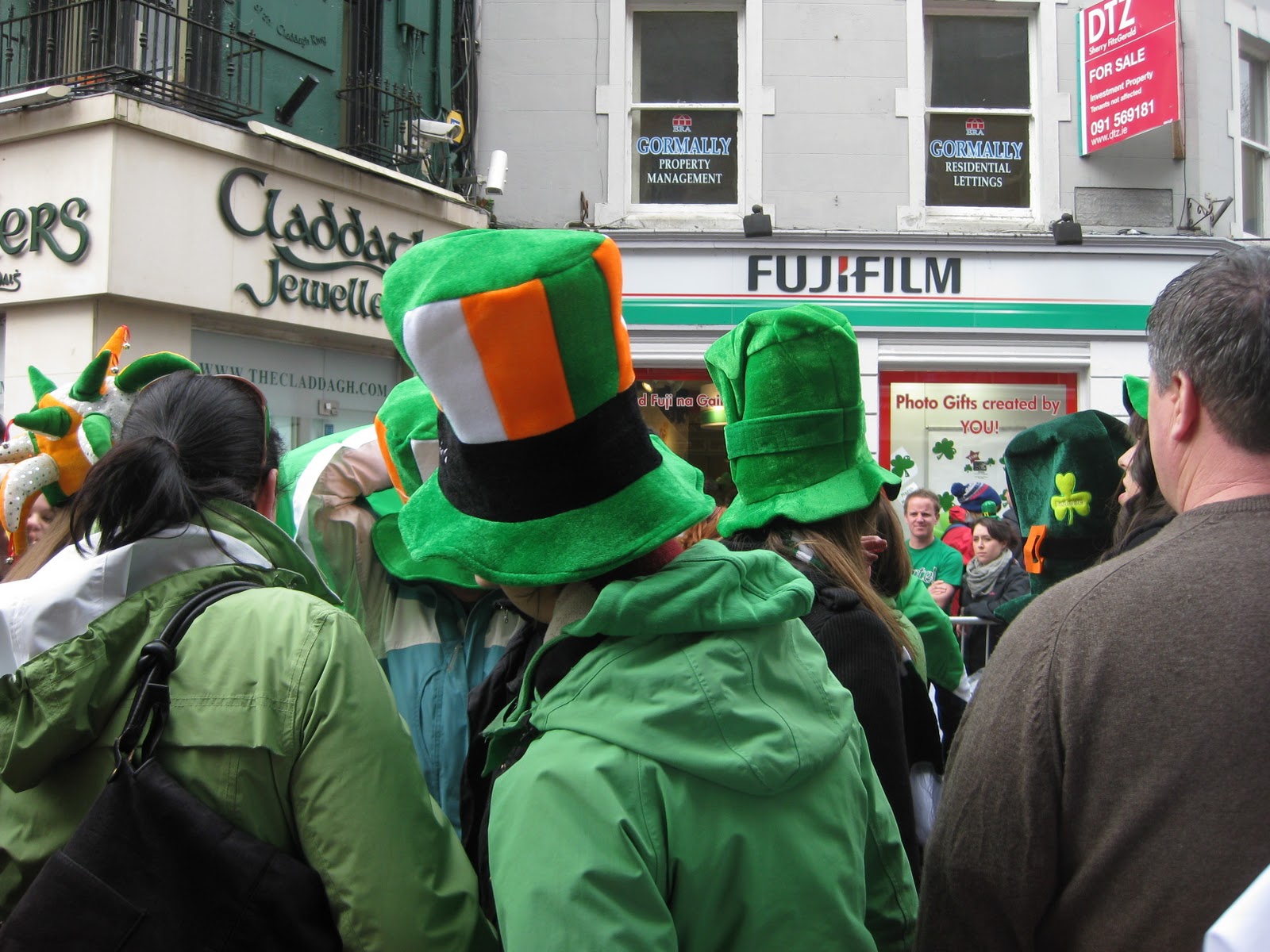
After a morning of working on my book, I ventured out at about noon.  The city felt different; the energy was high and there was light-heartedness in the air.  Mobs of people dressed in St. Patrick’s Day “finery” made their way through the town.  


The children, in particular, were adorable. 


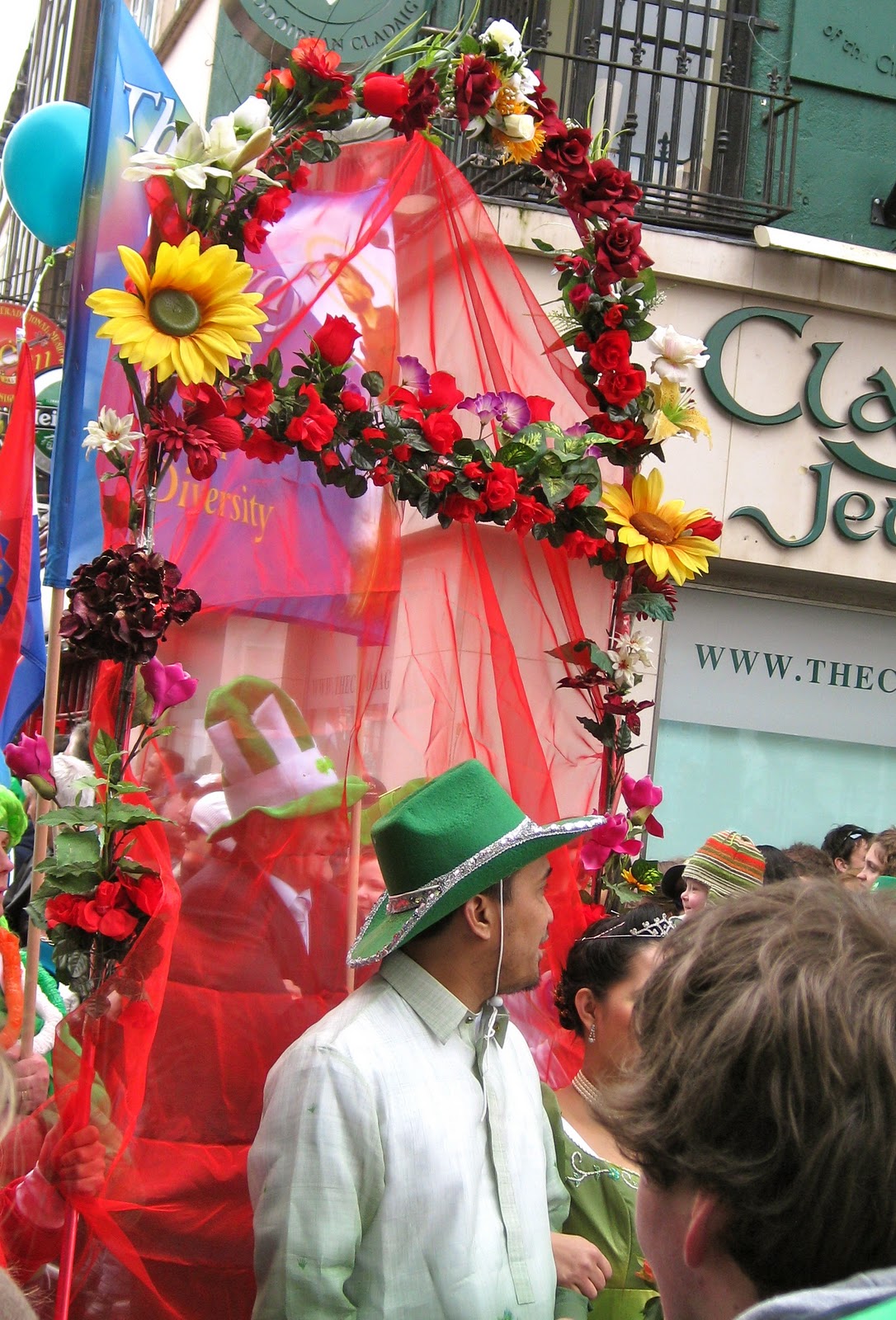
The Galway parade, reputed to be among the best in Ireland, kicked off at 12:30.  I found a decent spot without too many people in front of me.  I had to hold my camera up to get some of the shots, but I also was able to see quite a bit. 


The parade was very festive.  The participants were young and old and they represented a great many interests, activities and groups.  The parade was also very multicultural and it felt like a celebration of many cultures. 


I walked around for a while after the parade and it was clear that the celebration was continuing.  I went home, but I did watch people from my window as they wandered the docks.  That night was surprisingly quiet.  Or, the earplugs I wore worked. 


I am so glad I had a chance to celebrate St. Patrick’s Day in Ireland.  I’m sure I will remember it every year. 

“May you live all the days of your life.” 
Jonathan Swift

Friday, March 11, 2011

Scars of Our Own

Anyone who thinks the need for International Women's Day is over isn't living in the world with the women who get kicked in the stomach.  -Inez McCormack

Inez McCormack, Monday, March 7, 2011

Tuesday, March 8 people all over the world recognized and celebrated International Women’s Day.  Though no consensus exists on when the first International Women’s Day was celebrated, many consider 1911 to be that year, making this year the centenary.  The Global Women’s Studies Programme at the National University of Ireland Galway joined with four other organizations to offer a week of programs in honor of the centenary. 

On Monday I attended a lecture by Inez McCormack.   When Stacey Scriver Furlong from NUI Galway informed me of this lecture, she told me that McCormack is quite famous.  I had never heard of her, so I did some online research so I wasn’t walking in blind.  I learned that McCormack is considered one of the most influential civil rights leaders in Northern Ireland.  She was the first female president of Irish Congress of Trade Unions and she has a long history as a trade unionist advocating for the fair treatment of women and minorities in the workplace.  She also played a role in the 1998 Good Friday Peace Accord.

McCormack has been included in a New York play called “Seven” which tells the stories of seven women leaders from around the world.  Meryl Streep will play McCormack at a special reading of the play. 

McCormack’s presentation was inspirational.  She spoke of the “doctrine of unright time”—the well known occurrence when women ask for equal rights and are told, “I agree with you, but now is not the right time.”  In response, McCormack quoted Italian Jewish poet Primo Levi who spent time in Auschwitz.  Levi asked, “If not now, when?  If not us, who?  If not here, where?”

Saying it is never easy to fight for change, McCormack told the audience, she did not want us to have her scars.  But, she said, we must have scars of our own.  “You can’t do everything, but you can do something, and that’s what makes us dangerous.”


"God will not look you over for medals, degrees or diplomas but for scars."  
-Elbert Hubbard


Co-Directors of the Global Women's Studies Programme Nata Duvvury and
Niamh Reilly with Inez McCormack

Stacey Scriver Furlong and Niamh Reilly, Global Women's Studies Programme Staff

Inez McCormack and Rachel at reception after the presentation

Sunday, March 6, 2011

You Just Might Find, You Get What You Need

I am currently at the point in my sabbatical when I go the longest without a guest.  These days I am settled into a nice, quiet routine.  I work.  I eat.  I go for a walk.  I think.  I Skype.  I sleep.  I go to the grocery store.  I listen to a podcast.  My routine is comfortable and predictable.  It is also quite different from my first sabbatical in Florence, Italy. 

I have had occasion to reflect on the difference between my two international sabbaticals and I thought I might enjoy capturing my reflection “on paper.”

One significant difference between my two sabbaticals is that I travelled more in Italy than I have around Ireland and there are many reasons why this is true.  First, public transportation is easier in Italy.  The trains reach more places and run more frequently.  People use buses in Ireland quite a lot and they take more time.  Second, public transportation here is expensive.  Train and bus tickets cost less when purchased in advance online, but they are still pricey.  On more than one occasion I have thought, “I should take a day trip to…” and then I consider the cost of getting there and back and decide to stay in lovely Galway. 

One place I have travelled several times in Ireland:  the Connemara Region
One of two trips to Venice
St. Peter's Square, one of many trips to Rome
Third, I’m afraid to drive in Ireland.  People I know who have travelled here have said, “You have to rent a car.”  I see what they mean.  The thing is, people drive on the left side of the road and the driver sits on the right side of the car.  I have heard some say, “You get used to it right away” and others claim emphatically, “I would NOT recommend it.”  If I was just worried about a little fender bender, I could go for a spin.  I’m actually worried about injuring or killing somebody because I do something that has been programmed into my driving behavior for over 25 years.  I think some people have the ability to adjust naturally to the change.  I might.  I also might not.  I don’t think the risk of finding out is worth it. 

This was my bus stop in Florence, just around the corner of my apartment
Some things that were hard in Italy are easy here and vice versa.  When I lived in Italy, I used to have to prepare for every little encounter.  When I went to the post office or had to buy a screwdriver, I looked up and wrote down necessary phrases. The language barrier made simple, every-day tasks complicated.  On the other hand, my landlady paid all the bills associated with my apartment.  I had to look at the phone, gas and electric meters and determine what I owed, but Mrs. Gavilli picked up the money and that was the end of it for me.  Here I had to set up the services, deal with automatic payments vs. deposits and open a bank account.  Before I leave I have to close everything down.  On balance, though, day-to-day life is significantly easier here than it was in Italy. 

When I lived in Italy, I easily found a community of English speaking expatriates, most of the people were from Great Britain.  I have met a number of people here with whom I would say I am friendly (today one of them gave me a pair of wooden knitting needles), but I would not say I have made friends.  Yet.  Some ground work has been laid, but friendship here is taking more time.  In general the Irish are extremely pleasant and interesting and willing to talk, but they are not in need of new friends the way expatriates are. 

My expatriate friends in Florence at Angiolino's on my 36th birthday, two days before I left the country

I walked a lot in Florence, almost always to get somewhere.  Galway is significantly smaller so it’s less effort to get to the grocery store, church, etc.  When I walk here, I am often making it a point to go for a walk.

A typical scene on a walk in Claddagh Park, Galway

Technology has changed so drastically in the seven years between my sabbaticals that it almost doesn’t feel like the same kind of experience.  I had a little TV in Italy that received a few channels, but I didn’t understand the language.  When I was desperate for noise, I used to watch episodes of “Walker, Texas Ranger” dubbed in Italian.  It was almost the only show I could understand; the level of dialogue was not very high. Plus, it doesn't take a genius to understand a round kick to the face.  Ugh--not really my thing.

TV in my Florence apartment
In Ireland I was able to buy a cable/Internet/phone package for less than the same service costs in the United States.  The most significant part of this for me is the wireless internet connection.  I have constant access to email, websites, podcasts, etc.  I also have Skype and Kevin and I Skype almost every day.  It’s hard to remember that in Italy I had to walk about a half a mile to an internet café and pay by the minute for computer time. 

My closest computer and internet access in Florence

When I packed for Italy I brought a portable, battery-run CD player.  I have a vivid memory of sitting on the floor in my living room trying to decide which eighteen CDs I could bring with me for the year.  Torture!  Now I have an iPod as well as iTunes on my computer.  I can purchase new music and rent movies. 

Through technology I feel so much more connected to friends and family in the U.S. than I did when I was in Italy.  Just yesterday I Skyped with Mary and Patty Hawk and Mary was able to show me her kitchen renovations in process and I was able to give my (probably bad) opinion on wall color.  Last week I watched two different hearings (the first on an immigration bill and second to abolish the death penalty) online that took place in the Nebraska Legislature’s Judiciary Committee.  I knew almost every person who testified at the second hearing.  It blows my mind that technology “transports” me across the ocean. 
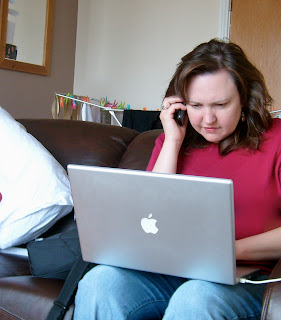
Using the laptop and phone at the same time
The most exciting thing I ever saw out my window in Italy was a disdainful cat or two.  On the other hand, Florence was filled with so many museums and churches and other works of art that I didn’t experience it all in the eleven months I was there.  My apartment on the docks provides me a constant show as well as views of Galway Marina, Galway Harbor and Galway Bay.  When I was in Italy, I used to extol the virtues of “staring at the wall.”  In Galway, I praise “staring out the window.” 

Picture of cats taken from my apartment in Florence
Activity I can see from my window in Galway
Almost everything is more expensive this time around:  utilities, groceries, rent, restaurants, transportation, coffee, cupcakes, etc.  Of course I had to watch my finances in Italy, but I don’t remember being constrained by a lack of money.   

Taken on a Dublin street
Last summer I would not have guessed that this sabbatical would be so different from my first.  Upon reflection, though, I believe I have had the perfect sabbaticals.  Italy provided what I needed at that point in my life and I believe Ireland is doing the same.  

Double rainbow over Galway Harbor


Sunday, February 27, 2011

An Historic Power Shift

As I am sure you are aware, Ireland is facing a severe economic crisis that has shaken many people to the core.  I have written about it in this blog in the past. Unemployment is very high (13.4% in January 2011) and extremely difficult cuts in the budget will have to be made.

Amidst the great economic disillusion, the lower house of parliament, called the Dail, was dissolved and a general election was held last Friday, February 25. 


Some elections have not been called yet, but it is certain that the long-ruling party Fianna Fail (pronounced something like “Fee-nay Fall”) has been soundly defeated.   This is no surprise to me.  As far as I can gather, almost everyone holds the ruling party largely responsible for the ongoing economic crisis.  Fianna Fail has been the largest party since 1932. 

For the first time in history, the Fine Gael (pronounced something like “Finn-eh Gale”) party has become the majority party.  The second largest party now is Labour with independents in third.  Fianna Fail has the fourth place.  Labour and Sinn Fein won more seats than ever before

Campaigning officially began on February 1 and ended on February 24.  Political ads are banned on TV and radio (imagine!), but there were several televised debates.  I also saw two local candidates campaigning last Sunday.  As I left church, they were ready and waiting with loud speakers to make their case to the emerging congregants.


The Irish election system is called “proportional representation by means of the Single Transferable Vote” (STV).  A voter is given a slate of candidates and s/he rank orders them.  I understand the processing of the votes can be complicated.  I watched some returns coming in today and I heard commentators mentioning a “seventh count,” etc. 

This Poster Asks People to vote for Fine Gael 1, 2, 3 and 4


I’m sure the language barrier was largely responsible, but I didn’t pay a whole lot of attention to Italian politics when I was on sabbatical in Italy.  With the exception of following Silvio Berlusconi’s seemingly frequent scandals, I was not tapped in to the Italian political world.  In contrast, I have found the Irish election fascinating.  I especially appreciate the short campaign period and the ban on TV and radio advertising.  How much of substance can you actually learn in 30 or 60 seconds anyway?

After mass this morning I talked a little bit about the election with Fr. Dick.  He was clearly immersed in the whole process.  He mentioned it in his homily and in his bulletin column.  Another man standing nearby said something like, “With all the attacks going on, you’d have to be crazy to run for office.”  Sadly, such things might be universal.  


Note:  I relied on Wikipedia for much of this information.  I also visited the Electoral Knowledge Network online and a few other economic websites.  Please forgive any mistakes.  

Sunday, February 20, 2011

Slainte


Drunkenness is nothing but voluntary madness. 
–Seneca the younger


When I go out walking on particularly nice days I often see young people gathered along the river in pairs and groups drinking beer or other alcoholic beverages.  Living as I do, on the docks, I awake on occasion in the middle of the night when loud and laughing drunk people walk past my building.  Last October I heard an extremely intoxicated woman jump into Galway Harbor in the middle of the night.  Worried for her safety, I got out of bed and looked out the window and saw her winter-coat wearing friend watching her from the dock.  I saw the "swimmer" half way up a ladder that leads to dry land, so I imagine she made it home cold, but safe.  

The Irish caricature is almost always a drinking or drunk person and I have taken care not to stereotype.  I have, however, wondered about the role of alcohol in Irish society.  Historically and currently, the Irish have had their share of hardship and yet they remain a warm, friendly, and welcoming people.


Last December I attended a panel discussion at the National University of Ireland, Galway on “Ireland, Alcohol, and Sexual Violence against Women.”  The Global Women’s Studies Program sponsored the panel. 

The first presenter, Dr. Stacey Scriver Furlong, discussed findings from a research project that looked at rape in Ireland.  She stated, “In Ireland, alcohol is the most common date rape drug.”  According to the study, in the rape cases that went to trial, 2/3 of the complainants and 88% of the defendants had been binge-drinking.  One disturbing story was told of a young man who consumed thirty pints of beer, returned home and raped his sister.  I find it almost impossible to imagine the trauma that family suffers.

In the last week I have seen a public service commercial on television that explains that it takes about one hour to metabolize one serving of alcohol.  After illustrating what constitutes one serving of alcohol, the commercial asks the viewer to consider if they might not be sober the morning after.  This commercial illustrates the culture of binge drinking I heard about at the panel in December. 

The presenters and audience members at the December panel view the drinking culture of Ireland to be a significant problem.  One person commented that while binge-drinking is a common problem for youth in other countries, it remains a problem for older adults in the Ireland.  Others shared that there are few social activities that do not involve alcohol.

A 2007 study* of alcohol use in Ireland found that
·      24% of 18 – 29 year olds drink 9 or more drinks on a “typical drinking occasion”
·      10% of drinkers reported drinking more than the “recommended weekly limit” of 21 drinks/week for men and 14 drinks/week for women
·      28% of drinkers reported binge drinking (defined as six or more drinks) at least once a week
·      Over half of all drinkers reported a harmful pattern of drinking


I’m not a teetotaler; I especially enjoy a glass of wine or two on occasion.  If Irish culture promotes binge-drinking, though, the consequences for personal and community health and safety are enormous.  Clearly, alcohol plays a role in sexual assault.  Alcohol is estimated to be a factor in one of three fatal car crashes in Ireland.  This does not even consider the effect of excessive alcohol use on personal relationships, and work and school performance. 

Ironically, the traditional Irish toast, “Slainte” literally means “health.” 


*Available at: http://www.dohc.ie/publications/pdf/slan_alcohol_report.pdf?direct=1


Tuesday, February 8, 2011

Churning: An Update


Washer/Dryer

I forgot how much noise my washer/dryer generates.  That’s right!--Laundry churns in my home once again! 

Last week Monday, the friendly repairman returned with the correct parts.  He had the machine fixed within thirty minutes.  When we were saying our goodbyes, he said, “I hope I don’t see you again.  Enjoy the rest of your time here.”  I took that in the kind manner in which it was intended. 

Since that day, I have delighted in doing my laundry.  Though I appreciated having my dirty laundry picked up and then delivered back to me clean, I enjoy that I don’t have to negotiate this task with other people.  Nor do I have to hand over money for the privilege. 

Clean sheets and towels  :-)

Galway Harbor
           
My last blog reported on the gale winds that struck Galway last Thursday.  I eagerly anticipated the report on the gale that I was sure to see on the news on Thursday night.  I did see the report, but I was struck by the matter-of-fact tone of the fairly short segment.  I imagine the Galwegians experience gale-force winds the way I experience a tornado warning:  I don’t like it, but I don’t go on and on about it.  It is simply a fact of life. 

The Irish Meteorological Service issued another gale warning for Friday.  I once again enjoyed the show from my perch by the window.  The water in the harbor looked different than it did the day before.  On Thursday, small waves of water moved across the harbor for short distances.  Some of the waves were strong enough to splash up on the concrete of the docks.   The wind picked up water and blew a significant amount of mist into the air.  On Friday, the harbor resembled a pot of bubbling and boiling water.  Occasionally a small amount of water would “boil” out of the harbor and onto the concrete; I kept imagining a hissing sound when it happened.   

Berating myself for avoiding the roof patio on Thursday, on Friday I made my way to the fifth floor armed with raincoat, camera and cell phone.  The sound of the wind howling through the patio doors started my heart beating with fear.  A resident of Aengus House needs to use a fob to both get onto and off of the patio and I had visions of being so battered by wind that I would be unable to open the door.  I like to characterize my decision not to go on the roof as wise, but others should feel free to consider me a wimp.  I’m not likely to argue.  I went outside to experience the wind on ground level where there is not so far to fall. 

When I woke on Saturday, the harbor was completely calm.  The orange wind sock that hangs on top of the Galway Harbor Company looked worn out and ill used.  The water was very brown from all the churning and I saw trash floating in the usually fairly clean water.

I was happy to get outside on Saturday and move around.  I did a number of errands and rather than return home quickly, I bought a newspaper and stopped for a relaxing lunch at Sweetie Pies.

I appreciate that I continue to have new experiences while doing the same old things—looking out my window and walking around Galway and Galway Bay.  Rest assured, I will report in this space on the next event of note.

A calm harbor, once again

Calm...  ahhh.....